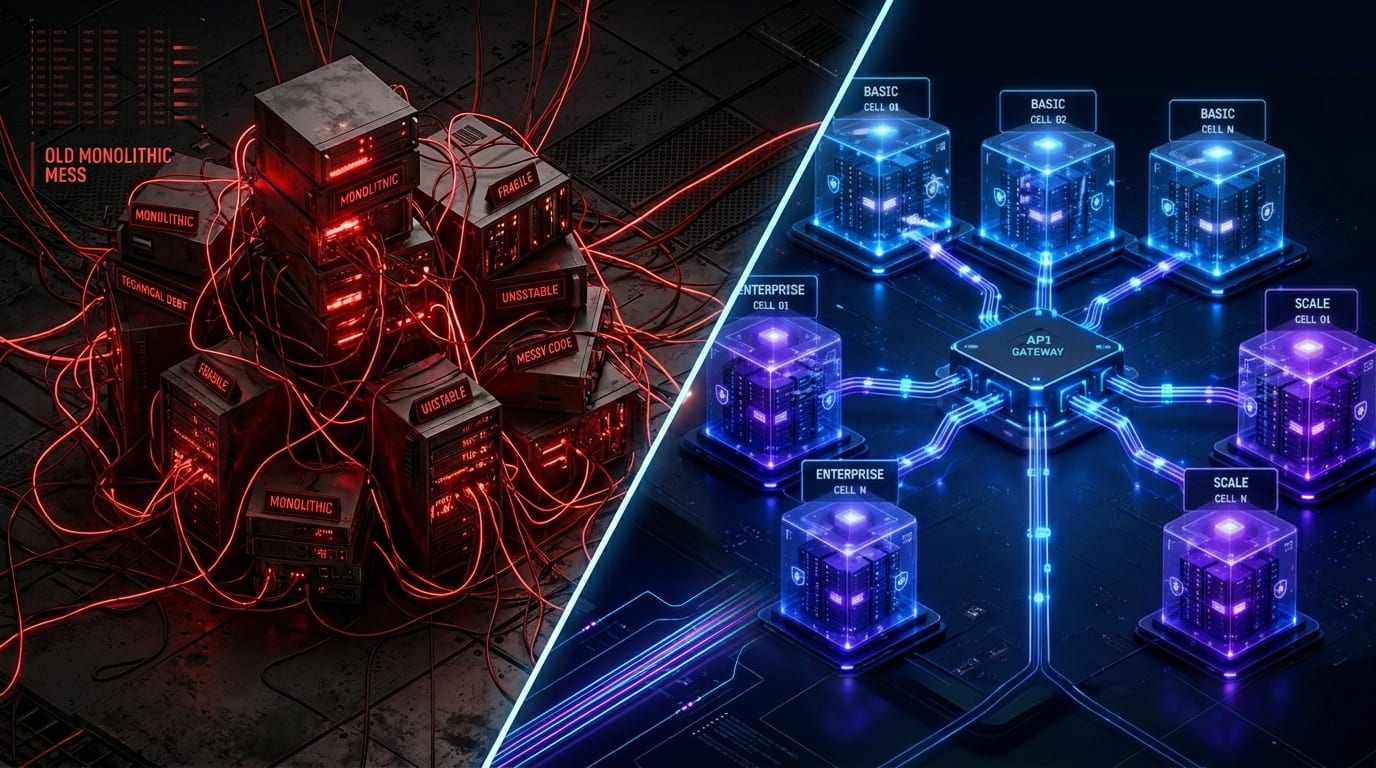
Nobody warns you when you're excited about launching your SaaS product. Nobody pulls you aside and says: "The database isolation decision you're making right now? You'll be rewriting it in eighteen months, under pressure, while a paying enterprise client watches."
I've been in that room. I've debugged the data leak. I've been the engineer staring at a Postgres connection pool exhausted because fifty tenants decided to run batch jobs at 7AM simultaneously. And I've also been on the other side — the one who built it right, who watched the system absorb five new enterprise clients in a single quarter without a single Slack alert going off.
Multi-tenancy isn't a footnote in your architecture document. It is your architecture. Get it wrong and everything downstream becomes a patch on top of a patch. Get it right and you've built a machine that scales with elegance.
Why Most Engineers Underestimate This Problem
Here's how the conversation usually goes in a startup:
"We'll just add a tenant_id column to every table."
Cool. Simple. Done. Ship it.
Then six months later: a junior engineer writes a JOIN without the tenant filter. Suddenly, Tenant A can see Tenant B's data. If you're lucky, you catch it in QA. If you're not, you catch it in your inbox, from a CISO, with the word "breach" in the subject line.
Or your biggest tenant — the one paying you $80k/year — starts hitting slow queries because the mid-tier tenant next door is running a data export. They call it a "performance issue." You call it a "noisy neighbor." Your CTO calls it a "churn risk."
The point is: multi-tenancy is a data isolation problem, a performance contract problem, and a trust problem — all rolled into one architectural decision. And there are really only a few ways to solve it, each with a distinct trade-off profile.
The Four Patterns
Pattern 01 — Silo: One Tenant, One Everything
Every tenant gets their own dedicated deployment. Separate database. Separate infrastructure. Same codebase, but completely isolated instances. Think of it like building separate houses for every family instead of a shared apartment complex.
What it gets right: The security story is airtight. There's no shared surface area — a bug in Tenant A's environment literally cannot affect Tenant B's. Compliance conversations become easy. Backup and restore are per-tenant, clean and auditable. When Tenant A needs to scale, you scale their stack without touching anyone else.
What it gets catastrophically wrong: You've agreed to manage N independent production systems. Every deployment becomes N deployments. Every config change is N config changes. Every migration script now needs to run N times, in the right order, without failing halfway through on Tenant #34.
I've seen teams with forty enterprise tenants who needed three full-time DevOps engineers just to keep the lights on. The infrastructure cost was eye-watering. The cognitive overhead was worse.
Use it when: Your clients are in regulated industries — healthcare, finance, government — with hard data residency requirements, or when you have a small number of very large, very demanding enterprise accounts.
Pattern 02 — Pool: Shared Everything
One database, one deployment, one everything. Tenants are separated by a tenant_id column (or row-level security policies) rather than by infrastructure. You deploy once, manage one database, pay for one set of servers. Adding a new tenant is a row insert, not a Terraform plan.
What it gets right: Speed of development. Ease of management. Economies of scale on infrastructure.
What it absolutely does not forgive: Your code is now the only wall between tenants. One missing WHERE tenant_id = ? — one moment of carelessness — and you have a data exposure event. This isn't hypothetical. It happens. Regularly. Across companies you've heard of.
The noisy neighbor problem is real and unsolvable in the pure pool model. Per-tenant backups are also surprisingly complex — restoring one tenant's data without affecting others requires point-in-time recovery scoped to a specific tenant, which means additional engineering investment.
[!WARNING] Row-level security in Postgres helps enforce tenant filtering at the DB level, but it's not a silver bullet. Application-layer bugs can still bypass it if connections are reused improperly or RLS policies aren't configured with care.
Use it when: You're early-stage, optimizing for velocity, with many small tenants and low data sensitivity.
Pattern 03 — Bridge: Shared App, Isolated Databases
One codebase. One deployment. But every tenant gets their own database. The application layer inspects the incoming request, identifies the tenant, and routes the connection to the correct database at runtime.
What this solves: True data isolation at the database level. No missing WHERE clause can cross tenant boundaries because the databases are physically separate. Tenant-level backups are clean. Compliance conversations get easier.
What it introduces: Connection pool management becomes non-trivial. You need a pool per tenant, warm connections up for active tenants, evict idle ones, and handle the burst of Monday-morning logins when 200 tenants authenticate within the same fifteen-minute window. Get this wrong and your app server runs out of database connections in production.
Database migrations are also more involved — schema changes need to run across N databases, typically via a migration runner that processes tenants in batches with rollback support.
This is the "grown-up pool model." You keep most of the operational simplicity, trading a bit of connection management complexity for real data isolation.
Pattern 04 — Cell-Based: The One Worth Designing Toward
This is where things get interesting — and this is the pattern I used to build a production fintech platform, in a hybrid form that's more practical than what most architecture textbooks describe.
A "cell" is an independent unit of infrastructure: same codebase, one database, one deployment, capable of serving N tenants. You don't have one giant shared system. You have a fleet of cells, each handling a bounded slice of your tenant population. A global API Gateway sits in front, inspecting every incoming request and routing it to the correct cell.
The question most explanations skip: how do you decide what goes in which cell?
Cell-Based in Practice: The Fintech Platform
Here's the exact model I built, and why each tier exists.
The Growth Cell
One cell, shared database schema with merchant_id as the tenant discriminator, hosting up to 100 smaller tenants on the base plan. These tenants don't generate enough load to meaningfully step on each other. You accept a small noisy-neighbor risk in exchange for extreme infrastructure efficiency.
The Scale Cell
Same architecture, same code, same database structure — capped at around 10 tenants. For growing mid-market customers, fewer tenants per cell means each one gets a larger share of available resources. You pay more per-tenant in infrastructure, but you're delivering a better product to a customer segment that's paying you more per seat.
The Enterprise Cell
Full isolation. One cell, one tenant. A dedicated database, dedicated deployment, in whichever cloud region the enterprise client requires — potentially behind their private network. And here's the elegant part: it's still the same codebase. Your engineers don't need to context-switch into "enterprise mode." The infrastructure does the work of isolation, not the application logic.
The API Gateway
A gateway performs tenant resolution on every request. It reads the incoming token or domain, looks up which cell owns that tenant, and routes accordingly. The application itself has no knowledge of the cell structure — it just serves the tenant in front of it.
[!IMPORTANT] The routing lookup must be sub-millisecond. Cache your tenant-to-cell mappings aggressively — Redis works well here. A cold DB lookup on every request will quietly destroy your p99 latency before you even notice it in dashboards.
The Trade-Off Matrix
| Pattern | Data Isolation | Noisy Neighbor | Infra Mgmt | Tenant Backups | Scale Ceiling |
|---|---|---|---|---|---|
| Silo | Strong | None | Nightmare | Easy | Low |
| Pool | Code only | High risk | Simple | Complex | Medium |
| Bridge | DB level | Reduced | Moderate | Clean | Med-High |
| Cell-Based | Per cell | Controlled | Gateway | Per cell | Unlimited |
No pattern wins on every dimension. The Silo model gives you perfect isolation but collapses under operational weight. The Pool model is fast to build but puts all your trust in developer discipline. The Bridge model is the pragmatic middle ground — until your tenant count makes connection management a full-time job. Cell-Based lets you tune each tier's trade-offs independently, which is why it scales.
Three Questions to Answer Before You Choose
Before picking a pattern, be honest with yourself about these:
1. Who are your tenants, really? One hundred SMBs with similar usage patterns are a different problem than ten enterprises with wildly different load profiles. The pool model was designed for the former. Cell-based was designed to accommodate both.
2. What's your actual compliance surface? If even one tenant is a financial institution or healthcare company, assume they'll eventually ask for a data isolation guarantee you need to honor. Design for it before that conversation happens, not during it.
3. What's your team's operational maturity? The silo model's overhead will break a five-person team. The pool model's security surface will punish a team without strong code review culture. Be honest about where you are before committing to an architecture that requires you to be somewhere you're not.
The Part Nobody Puts in the Blog Post
Every pattern I've described has an implicit assumption baked in: that you decide which one you're using, upfront, intentionally.
The engineers I've seen struggle the most didn't choose wrong — they didn't choose at all. They added a tenant_id column because it was fast, shipped it, then found themselves three years later retrofitting data isolation onto a system not designed for it, under the pressure of an enterprise deal that hinged on passing a security audit.
Migration from pool to bridge, or bridge to cell-based, is not impossible. But it's expensive, risky, and deeply unpleasant. It touches every table, every query, every ORM model, every API endpoint. It's the kind of project that takes six months and requires a feature freeze.
The cost of thinking carefully about this now is an afternoon and a whiteboard. The cost of not thinking about it can be an architectural rewrite that occupies your best engineers for half a year.
What I'd Actually Build Today
If I were starting a new SaaS product with real ambitions, I'd design for cell-based architecture from the beginning, even if the first deployment is a single cell.
The beauty of designing with cells in mind early is that your first cell is your MVP. You build the gateway routing logic (which starts trivially simple, "all tenants go to cell-1"), you build the shared schema with merchant_id discipline, and you ship. When you land your first enterprise client, you provision a dedicated cell for them. The gateway update is a configuration change, not a re-architecture.
You don't build the full fleet on day one. You build the shape that lets the fleet grow without structural surgery.
That's the difference between an architecture you chose — and one that chose you.