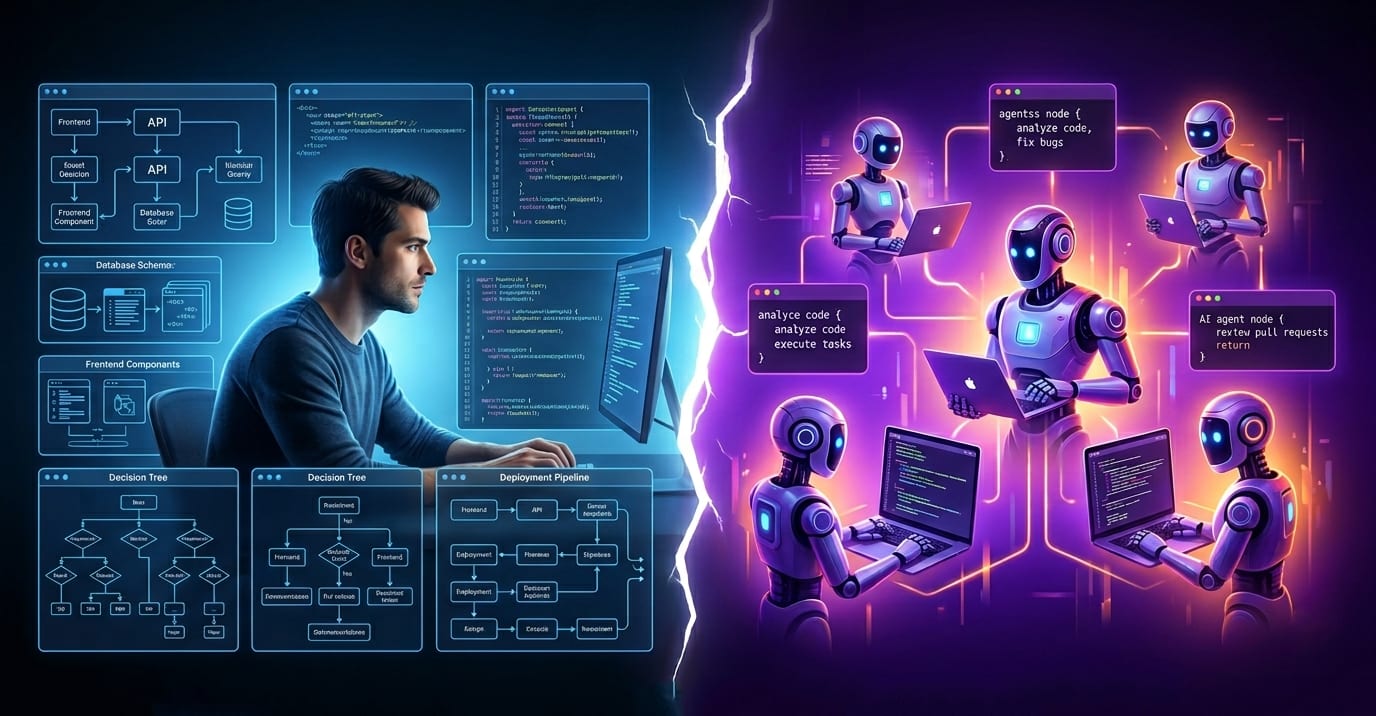
Picture the last complex feature you shipped. You designed the data model, wrote the API, wired the frontend, handled the edge cases, and deployed it. Every decision — every branch, every fallback, every retry — was yours. The system did exactly what you told it to do. Nothing more.
Now picture software that reads your codebase, identifies a bug, writes the fix, runs the tests, opens a pull request, and pings you only if something looks off.
You didn't write that logic. You didn't define those branches. The system decided.
That gap — between software that executes and software that reasons — is the most significant architectural shift in a generation. And most engineers are still writing code as if it doesn't exist yet.
The World We Built: Determinism as a Feature
Traditional software is a monument to predictability. You write a function. Given the same inputs, it returns the same outputs. Every time. Forever. The entire discipline of software engineering — unit tests, type systems, formal APIs, idempotent operations — is built on the comforting assumption that machines do what they are told.
This determinism wasn't a limitation. It was the point.
You could reason about your system statically. You could trace a bug through a call stack. You could read the code and understand, with certainty, what would happen next. Software was a machine with known parts — complicated, yes, but ultimately traceable.
Debugging meant finding the line where reality diverged from intention. Deploying meant shipping a defined artifact. Monitoring meant watching numbers against thresholds you understood.
The mental model was: intent → code → deterministic execution.
That model still works for most of what we build. But a new class of systems has appeared that it cannot describe.
The Arrival of Something Different
Autonomous agents don't execute instructions. They pursue goals.
Give an agent a goal — "research this topic and draft a summary," "triage these support tickets," "refactor this module to improve test coverage" — and it will break the goal into steps, decide which tools to use, evaluate intermediate results, course-correct when something fails, and continue until it either succeeds or determines it can't. The control flow isn't in your code. It's in the model's reasoning.
This isn't a smarter autocomplete. It's a categorically different computational model.
The question for engineers isn't whether agents will become load-bearing parts of software systems. They already are. The question is whether you understand what you're building when you reach for them.
Here's what changes — almost everything about how you design, build, debug, and trust software.
The New Architecture: What an Agent Actually Is
Before the philosophy, the plumbing. An autonomous agent at its core is a reasoning loop wrapped around a set of tools.
In practice this means:
- 01A context window as working memory — the agent's current world model, including its goal, tool results, conversation history, and any retrieved context.
- 02Tools as actuators — functions the agent can call: web search, code execution, database reads, API calls, file I/O. The agent decides when to call them and what to do with the result.
- 03A planner or reasoning trace — the chain-of-thought that decomposes a high-level goal into a sequence of steps, re-evaluated at each iteration.
- 04An orchestrator — the outer loop managing the agent: injecting context, enforcing guardrails, persisting state, and deciding when the task is complete.
Your job as the engineer has shifted. You're no longer writing the logic. You're designing the environment the agent reasons within.
What Actually Changes for Engineers
1. You're Designing Systems That Make Decisions
In traditional full-stack development, a decision in the codebase looks like this:
The decision is yours. It lives in the code. It's auditable, testable, reversible.
In an agent-based system, the equivalent might be a prompt:
The decision is now emergent. It will depend on the model, the context, the phrasing of the prompt, and subtle interactions you cannot fully anticipate. You can guide it. You cannot guarantee it.
This is not a reason to avoid agents. It's a reason to understand the new contract: you are now shipping a system with probabilistic behavior, and your engineering practice needs to adapt accordingly.
Treating an LLM-backed decision as if it were a deterministic function is the most common architectural mistake in agent systems today. Test coverage that passes 100% in CI tells you nothing about production behavior when the input distribution drifts.
2. Evaluation Becomes Your New Test Suite
You can't unit test an agent the way you unit test a function. The output space is too large, too context-dependent, and too dependent on model behavior that changes between versions.
What replaces unit tests isn't less rigorous — it's differently rigorous. Evals are structured datasets of input scenarios with expected outputs or rubrics, used to measure agent behavior statistically rather than deterministically.
| Traditional Testing | Agent Evaluation |
|---|---|
| Binary pass/fail | Scored rubrics (0.0–1.0) |
| Input/output assertion | Behavioral coverage across distributions |
| Runs once per commit | Runs on model updates, prompt changes, context shifts |
| Catches regressions exactly | Catches capability drift probabilistically |
| Written by the author | Often requires domain expert annotation |
Building a good eval harness before you build the agent is the equivalent of writing tests before writing code. It forces you to define what "correct" even means for a non-deterministic system — which turns out to be one of the hardest problems in applied AI engineering.
3. Failure Modes Are Alien
In a traditional system, failure has a shape you recognize. A null pointer. A timeout. A 500. The system stops doing the right thing in a way that is loud.
Agents fail quietly. And they fail in ways that are genuinely strange.
- Goal drift: The agent correctly executes sub-steps but gradually optimizes toward a slightly different goal than you intended. The outputs look right until they don't.
- Context poisoning: An early tool call returns misleading data. The agent never questions it — it builds subsequent reasoning on a false premise.
- Infinite reasoning loops: The agent cannot determine whether a task is complete, oscillates between two strategies, and consumes tokens (and money) indefinitely.
- Sycophantic confirmation: When asked to verify its own output, the agent agrees with itself rather than genuinely checking. Self-review without adversarial structure is theatrical.
- Over-delegation: A parent agent hands off a task to a sub-agent. The sub-agent hands off further. Nobody calls back. The task disappears into a recursion tree.
Agents in production need hard limits — maximum steps, maximum tool call depth, maximum token budget, and circuit breakers that fail loudly rather than drift silently. Design these upfront. Retrofitting guardrails after an incident is always more painful than you expect.
4. Memory Is Now an Engineering Problem
Stateless functions were simple to reason about. Agents aren't stateless — and managing what an agent knows, remembers, and forgets is a first-class engineering concern.
There are three distinct memory layers to design for:
Working memory is the context window — whatever the agent can see right now. It's fast, expensive, and finite. Decisions about what to include here are critical; irrelevant context degrades reasoning and wastes budget.
Episodic memory is the log of what the agent has done in past sessions — previous tool calls, prior task outcomes, user interactions. This lives in a database you design and query with retrieval strategies.
Semantic memory is a vector store of encoded knowledge — docs, codebases, domain facts — retrieved by similarity when relevant to the current task.
Getting this architecture right is not a configuration problem. It's a systems design problem, with the same tradeoffs you'd consider in any distributed system: freshness vs. cost, recall vs. precision, consistency vs. latency.
The Skills That Transfer (and the Ones That Don't)
Here's the honest map.
Transfers well:
- Systems thinking and decomposition — agents are distributed systems with failure modes; your instincts about fault tolerance, idempotency, and retry logic are directly applicable.
- API and tool design — the tools you give an agent are APIs; poorly designed interfaces confuse agents exactly the way they confuse human developers.
- Performance and cost discipline — a poorly scoped agent context is a slow, expensive query; the same profiling mindset applies.
- Debugging through observation — you can't step through an agent with a debugger, but you can instrument traces; structured logging and observability matter more, not less.
Requires new thinking:
- Prompt engineering as a first-class skill — not in the "write a better ChatGPT prompt" sense, but understanding how context framing, instruction ordering, and few-shot examples shape model behavior in ways that compound across a multi-step agent trace.
- Probabilistic reasoning about correctness — getting comfortable saying "this system is right 94% of the time on this task distribution" and making product decisions from that, rather than demanding 100%.
- Eval-driven development — designing rubrics, building annotation pipelines, measuring behavioral coverage, and understanding what a regression in agent quality actually looks like.
- Trust architecture — deciding, deliberately, which decisions the agent makes autonomously versus which ones require human review. This is not a product decision; it's a safety-critical engineering decision.
Multi-Agent Systems: Where It Gets Genuinely Complex
Single agents are tractable. Multi-agent systems — where agents spawn sub-agents, delegate tasks, and aggregate results — introduce coordination problems that will feel familiar to any distributed systems engineer and unfamiliar in every other way.
Consider an orchestrator agent that manages a research workflow:
Each agent has its own context, its own failure modes, its own tool access. The orchestrator must:
- Route tasks to the right sub-agent
- Handle partial failures gracefully
- Resolve conflicts when agents disagree
- Avoid infinite delegation loops
- Maintain coherent state across the full pipeline
These are consensus, coordination, and fault-tolerance problems. The CAP theorem doesn't stop applying because the nodes are language models instead of databases.
Start single-agent. Get it working end-to-end, build your eval harness, understand the failure modes. Multi-agent architectures add significant complexity and should be justified by a concrete capability gap, not architectural enthusiasm.
The Philosophical Shift Engineers Need to Make
Here is the hardest part, and the part that most technical writing on agents skips:
You have to give up the illusion of full legibility.
The dream of traditional software engineering is that a sufficiently thorough engineer can understand exactly what a system does. The code is the ground truth. The behavior follows from it.
Agents break this. The reasoning trace gives you a window into what the agent decided. It rarely gives you a complete account of why in a way that satisfies an engineer's intuition about causality. You can log the steps. You can reproduce the inputs. You can re-run the eval. But the internal mechanics of a billion-parameter model arriving at a conclusion are not legible the way a for-loop is legible.
This is uncomfortable. It should be. The discomfort is appropriate.
The response isn't to avoid agents. The response is to build systems with behavioral constraints rather than behavioral specifications — to design the walls of the room the agent operates in, rather than scripting every move the agent makes inside it. Clear task scope. Hard resource limits. Human checkpoints at high-stakes decisions. Adversarial evals that probe edge cases. Monitoring that watches outputs, not just errors.
It's engineering by envelope, not by blueprint. It takes different instincts. But they're instincts that engineers are fully capable of developing.
What This Actually Means for Your Next Project
If you're building or evaluating agent systems today, here's where to put your attention:
- 01Define the task boundary precisely. Vague goals produce vague agents. The more tightly scoped the task, the more evaluable and reliable the agent.
- 02Build your eval harness before you build your agent. You need a definition of success before you can measure progress.
- 03Treat your prompts as code. Version them. Review them. Test them. Prompt changes that aren't tracked are the silent regressions of agent systems.
- 04Design the tools your agent uses as carefully as public APIs. Ambiguous tool descriptions lead to misuse. Overly broad tool access creates security surface.
- 05Put humans in the loop for high-stakes decisions. Not because the agent can't decide, but because the cost of a wrong autonomous decision must inform where you draw the line.
- 06Monitor behavior, not just uptime. An agent that runs successfully but pursues the wrong sub-goal is worse than an agent that crashes loudly.
The Shift Is Already Here
The engineers who will build the most consequential software of the next decade aren't the ones who resist this transition or romanticize it. They're the ones who approach it the way they've approached every paradigm shift before it: with rigor, skepticism, curiosity, and the discipline to build things that actually work.
Full-stack development isn't going anywhere. Deterministic systems will remain the backbone of most software for a long time. But the frontier has moved. The new surface area — where software doesn't just execute but reasons, decides, and acts — is where the hardest and most interesting problems now live.
The engineers who learn to build there, with the same craft they brought to building everywhere else, will define what software becomes next.
The question isn't whether you'll work with agents. It's whether you'll understand them well enough to build something worth trusting.